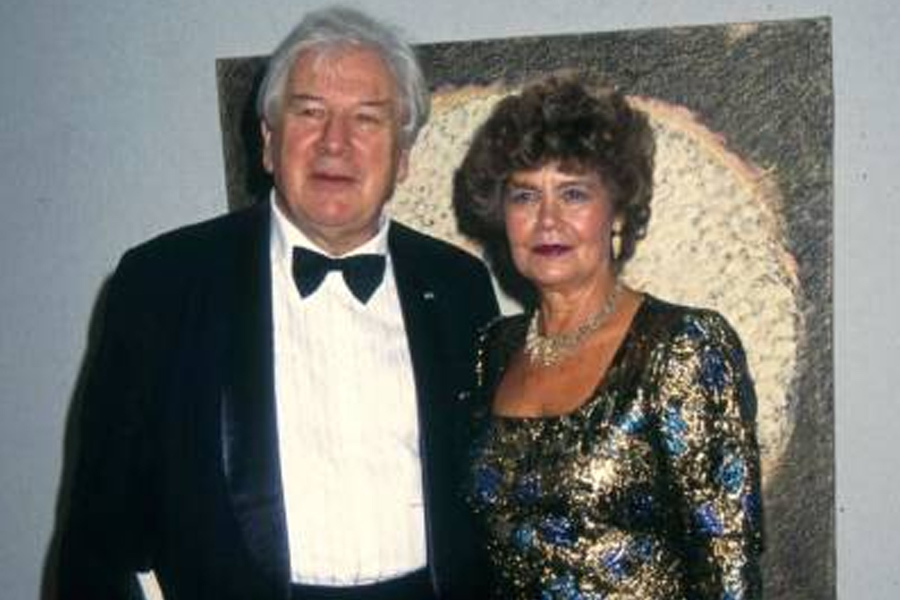
Hélène du Lau d’Allemans, better known as Lady Hélène Ustinov, was a French aristocrat, journalist, internationalist, and one of the 20th century’s most extraordinary artists. Despite being less visible than her husband, British actor and writer Sir Peter Ustinov, she was a significant part of his personal and professional life for over 30 years.
She was born in Paris’ 16th arrondissement on June 27, 1926. She died there at 87 on May 14, 2014. She worked in journalism, worldwide travel, humanitarian work, French nobility, and the difficult world of a recognised performer between those dates.
Helene’s narrative intrigues me because it doesn’t revolve around public performances or published works. It is a narrative of stage-side impact. She encouraged Ustinov’s humanitarian work and helped him maintain a private life despite his fame.
A French Noble Family Background
Helene was born into the family of the Marquis du Lau d’Allemans, an old French noble line. Her father was Armand, also known as Léopold, Marquis du Lau d’Allemans, who lived from 1886 to 1968. Her mother was Françoise de Ludre, born in 1902 and deceased in 1980.
The family was related to the de Ludre and de Suzannet lines. Helene’s heritage placed her in a traditional social environment of titles, estates, family names, and documented genealogy. She was more than her upbringing. Journalism and writing indicated an autonomous intellectual life beyond her family name.
Jean du Lau, born 1924 and killed in 1943, Henri du Lau d’Allemans, and Jacqueline were her siblings. Later, Henri was Marquis du Lau d’Allemans. Helene kept Jacqueline and Henri close, even after Peter Ustinov’s death.
Family history included luxury and grief. Jean’s Second World War death was an early sorrow, yet noble family names carried on down through generations. Helene lived at the intersection of a declining aristocracy and a globalised civilisation.
Helene De Lau’s Work as a Journalist
Helene’s journalism is few compared to Peter Ustinov’s acting, writing, directing, and public appearances. Her significant bylines and independent publications are rarely documented, yet she is always described as a French journalist and writer.
That lack of detail is not a sign of inactivity. Journalists write about culture, interviews, communication, editing, and worldwide events. Her position provided Helene access to artists, politicians, diplomats, and humanitarians, especially after her marriage to Ustinov.
She was more than a pretty face at public events. Her intelligence, experience, and background helped her navigate the difficult social and professional environment of a global celebrity. Even though her function was discreet, discretion might be strong.
Marriage to Peter Ustinov
Helene married Peter Ustinov on June 17, 1972, in a private ceremony in Cagnano, Corsica. At the time, Ustinov was already internationally famous as an actor, playwright, director, novelist, raconteur, and public intellectual. He had also been married twice before.
Their marriage lasted until Ustinov’s death on March 28, 2004. It was childless, but accounts of their relationship frequently describe it as supportive and happy. Ustinov spoke warmly about Helene and credited her with helping him become “something approaching the man I once hoped to be.”
That phrase shows his emotional attachment to her. Travel, public expectations, and health issues plagued Ustinov, a wit and verbal prodigy. Helene gave a life that often changed stages continuity.
They lived in Britain and Switzerland. In Ustinov’s final years, they lived in Bursins, Switzerland. She helped him manage diabetes, heart problems, and ageing. Their relationship went beyond looks. There was also practical care, loyalty, and companionship.
A Companion to Ustinov’s Humanitarian Work
From 1968 to 2004, Peter Ustinov was a UNICEF Goodwill Ambassador. He eventually made UNICEF a major public concern. In Cambodia, China, Egypt, Kenya, Myanmar, Russia, and Thailand, he met children and promoted poverty, education, health, and children’s rights.
Helene was part of the personal world that enabled this work. Ustinov’s humanitarian work involves long journeys, public appeals, governmental meetings, and emotional contacts with disadvantaged children. He was a powerful advocate because he could tell stories and use humour, but he was also busy.
Fame helped him gather funding and persuade governments to care for children. His work helped multinational organisations adopt the celebrity humanitarian ambassador approach. Helene’s assistance was less evident but underpinned that public service.
The Ustinov Family
Through her marriage to Peter Ustinov, Helene became stepmother to four children from his earlier marriages.
| Family member | Relationship to Peter Ustinov |
|---|---|
| Tamara Ustinov | Daughter from his marriage to Isolde Denham |
| Pavla Ustinov | Daughter from his marriage to Suzanne Cloutier |
| Andrea Ustinov | Daughter from his marriage to Suzanne Cloutier |
| Igor Ustinov | Son from his marriage to Suzanne Cloutier |
Extended family relationships were not always close. After Ustinov’s death, tensions increased since his children had distinct parental experiences. Large estates often involve convoluted family histories, legal issues, and personal grievances.
Igor Ustinov later became associated with the Sir Peter Ustinov Foundation, which was co-founded with his father in 1999. The foundation continued the humanitarian spirit of Ustinov’s work by focusing on education, living conditions, and opportunities for children and young people.
Inheritance and Estate Disputes
After Peter Ustinov died in 2004, questions surrounding his estate created conflict between Helene and some of his children. His assets included property, artwork, scripts, awards, personal belongings, and other materials connected to his long career.
Switzerland’s intestacy laws dispersed the inheritance when a will was rejected. This arrangement favoured Helene as his surviving spouse and caused family legal issues. The disputes proceeded through legal actions and property and Ustinov’s collection sale discussions.
The dispute illustrates how a famous person’s possessions can become more than objects. A script may represent a career. A painting may carry a memory. A house may become a symbol of belonging. When those things are divided, family history often rises to the surface.
Helene’s financial position after Ustinov’s death appears to have been comfortable, supported by inheritance and her own aristocratic family background. Precise details of her personal finances remained private.
Public Appearances and Private Reserve
Helene and Ustinov are photographed together at public events, social gatherings, international excursions, and family gatherings. She joined him to picnics, Rome, San Francisco, and political and cultural events. She joined the group that supported his public activities without expecting recognition.
Helene was central to the family at Ustinov’s 2004 Geneva funeral. She was with her siblings Henri and Jacqueline. The ceremony ended a 32-year marriage and began a painful era of grieving, legal obligations, and legacy administration.
Helene kept her privacy. No huge media campaign, constant interviews, or notable public identity separate from her family and marriage existed. In fragments, family records, photographs, biographical references, society reports, and Ustinov’s final years preserve her story.
A Timeline of Helene De Lau’s Life
| Year or date | Event |
|---|---|
| June 27, 1926 | Hélène du Lau d’Allemans is born in Paris |
| 1943 | Her brother Jean du Lau dies |
| 1968 | Her father, Armand Marquis du Lau d’Allemans, dies |
| June 17, 1972 | She marries Peter Ustinov in Cagnano, Corsica |
| 1999 | The Sir Peter Ustinov Foundation is co-founded |
| 2004 | Peter Ustinov dies in Switzerland |
| 2004 onward | Estate disputes involve Helene and Ustinov’s children |
| May 14, 2014 | Helene dies in Paris at age 87 |
Frequently Asked Questions
Who was Helene De Lau?
Helene De Lau was a French journalist and member of the noble du Lau d’Allemans family. She was best known internationally as the third wife of British actor and writer Sir Peter Ustinov.
What was Helene De Lau’s full name?
Her full name was Hélène du Lau d’Allemans. She was also known as Helene du Lau d’Allemans and Lady Hélène Ustinov.
When did Helene De Lau marry Peter Ustinov?
She married Peter Ustinov on June 17, 1972, in a private ceremony in Cagnano, Corsica.
Did Helene and Peter Ustinov have children?
No. Their marriage was childless. Peter Ustinov had four children from his two earlier marriages.
Who were Peter Ustinov’s children?
His children were Tamara Ustinov, Pavla Ustinov, Andrea Ustinov, and Igor Ustinov.
What happened to Helene after Peter Ustinov died?
After his death in 2004, Helene dealt with his estate and related family disputes. She remained connected to the management and distribution of his possessions until her death in Paris in 2014.
What was Peter Ustinov’s connection to UNICEF?
Ustinov served as a UNICEF Goodwill Ambassador for more than three decades. He visited countries around the world, advocated for children’s rights, raised funds, and used his public reputation to highlight poverty, health, and education issues.
When and where did Helene De Lau die?
Helene died on May 14, 2014, in Paris, France, in the 16th arrondissement.